There is one surprising fact about Operating Systems, unlike Web-Based applications, which follows dozens of different architectures or frameworks like MVC, Micro Services, micro framework, Service Oriented Architecture(SOA), the most complex system in the world, the Operating System has only 2 categories
Unix-like Operating System
Windows NT Family
All successful Operating System falls in one of these 2 categories.
For ex, Linux, macOS, even Android and IOS are Unix-like Operating Systems, and Windows Operating Systems belong to the Windows NT (New Technology) family.
For Operating System lovers and even for any other developer, it is extremely necessary to see how and why Unix became so important that even Apple and Linux borrow operating system base from Unix, why Unix was so perfect that the entire world not only adapted Unix but Operating Systems that adaprted Unix became extremely successful Operating Systems like Linux and Mac OS.
Even Windows follows a separate Kernel space philosophy from Unix.
Unix story has everything that curious programmers would love to know, like legendary computer scientists Dennis Ritchie and Ken Thompson, a legendary programming language like C, and legendary research work from various researchers that shaped the internet (BSD Sockets and TCP/IP)
Let’s start and see how Unix came into existence and became fthe ather of modern Operating Systems
Multics, the base of the Operating System Revolution
Before Unix, we need to understand the Multics Operating System.
Very few people know about Multics Operating System, but to Understand base of Unix we must also understand Multics.
Multics was an operating system developed by MIT, Bell Labs, and General Electric.
Multics was a mainframe Operating System, and Personal computers were not there at that time
Multics had a very big ambition; it was the first OS in the world that was made for Multitasking and Timesharing (Multiuser feature).
Fernando Corbato, the father of the sharing concept, was the project leader of Multics
It is curious to know which programming language Multics was written in because C was invented for Unix, and did not exist at that time
Multics was written in a programming language called PL/I (Programming Language One)
This language was created by IBM to solve system-related problems; it was compiled language and also had pointers.
PL/I was infamously complex and heavy; it was extremely difficult to make compilers for this language
Because of this language, Multics became extremely slow.
Eventually, Multics failed in the market, but already started an Operating System Revolution.
Another reason for Mulics’s failure was, it was ahead of its time; CPUs were not ready for this heavy operating system
Multics needed a large memory, Context switches required a fast speed
In 1969 finally Bell Labs finally decided not to invest more budget and time in Multics, and the Multics project officially ended
Hope and Frustration started making the foundation of Unix
Multics showed Scientists that it is possible to make a Multitasking and Multiuser Operating System, but they needed a possibility to make a good, stable, and budget-friendly Operating System that provides a Multiuser and Multitasking OS.
Legendary Scientist Ken Thompson did not want to go back to a batch processing system. Instead, he thought he would build a small Operating System at least for himself that would be interactive and multitasking, so the Unix project started, but as a personal project of Ken Thompson
In the same year, 1969 Multics project was ended, Ken started working on the PDP-7 Machine, which was not a very fast machine, but Ken was able to write a small kernel with few system calls.
This effort was effective enough to attract the attention of people at Bell Labs
The most important fact is that this little Kernel was a multitasking and multiuser Operating System, which is lightweight and gives output very fast, compared to Multics which was extremely slow in processing.
This little kernel became the foundation of the Unix empire
Entry of the Legend
Dennis Ritchie became interested in the Unix project and quickly started to improve the system by giving his input.
Dennis Richie was also working in Bell Labs and was a colleague of Ken Thompson.
One thing to remember, first small Unix kernel was written in Assembly language, so it was difficult to maintain, even harder than Multics because Assembly is more difficult to maintain that any other language, and most important things was, Assembly code is specific to CPUs, so portability was also not there, but one thing was sure, they were not going for PL/I, they thought they need to create their own Programming Language
B To C
Ken and Dennis created the B language, inspired by BCPL (Basic Combined Programming Language)
Even though they were able to write some tools in B language kernel was still mostly written in Assembly, because B has many limitations, like pointers were not that effective, data types were not there in B language, so they decided not to rewrite the kernel in B Language and think for the other solution.
Dennis was thinking about a language that could give more hardware control to them and should be portable so that Unix could be stable.
It was the year 1972 when Dennis started expanding the B language by adding data types; they even named it ‘New B’.
In 1973, expansion to B language was completed, and the most powerful language was born.
This time, they named the new language ‘C’ Language.
Rebirth of Unix with C
Ken and Dennis started rewriting the Unix Kernel in the C language and wrote all parts of the kernel in C, except critical components, which required Assembly code.
The birth of ‘C’,the base of modern Operating Systems, Internet Stack, Web Servers, Browsers, and many more software
While Unix was being rewritten in C, the world barely knew that fact that one of the most powerful Programming languages, ‘C’ language, had already been born.
The language that give programmers Memory control and high speed.
Even today, nearly all Operating Systems use C (not C++) to write core kernel components, and even Windows does the same.
Most Powerful Operating System, but restricted from being sold in the Market
Even though Bell Labs has created a milestone in the computing world, they could not sell this OS in the Market.
Bell Labs could sell Multics, but in case of Unix there was a hurdle for them, Bell Labs was connected with AT&T, which was facing an antitrust lawsuit due to it’s monopoly in the past.
There was a fear that AT&T is such a big company that could control ethe ntire computer industry, so the US Government restricted them from selling the software, and Unix future became uncertain
Unix and Universities
There was one way Unix could still be profitable, AT&T was allowed to do research, and they presented Unix as Research Project, and with a minor fee, they started selling Unix to Colleges and Universities.
In 1974, Unix started being sold to Universities.
Students and Professors loved Unix, and it became a turning point not only in Unix history but in the entire Computer World history.
The source code of Unix reached various colleges and universities, and contributions to the features and source code started coming.
Contributions made Unix a giant
University of California, Berkeley made a contribution that made Unix the modern operating System.
They gave Unix Networking Stack, Virtual Memory, TCP/IP.
Selling Unix to Colleges and Universities became a turning point for Unix
Back to Business-Restrictions Removed
In 1984 US Government broke up AT&T and restrictions of Unix removed; Unix became sellable
But Unix source code became closed and even became expensive; now they are selling it in the Market.
Unix source code became impossible to read for new programmers and hopes were getting vanished
Berkeley came to save Unix Community
Berkeley now started to fight for Unix community and Unix culture. They had already worked so much in Unix that they started removing AT&T code so that they could create Unix, which is not taking source from AT&T and then they can make this Unix called as BSD Unix available to Programmers
Unfortunately efforts of removing AT&T code took so long that programmers started to become frustrated.
One of the legendary coders, Linus Torvald,s started his own project, which was a Unix-like Operating System, Linux.
Why Unix became a super standard for Operating Systems
The basic fundamental architecture designed by Ken Thompson and Dennis Ritchie was so stable and mature that every company, community started following it. There were some efforts made to beat Unix standards like IBM OS/360/MVS, OS/2, but they could not beat Unix, even though they had tons of funds.
One reason of Unix’s stability can be the research and contributions of source code came from Universities, which made Unix standards unbeatable
Unix was the only reason the POSIX standard was made, and following the POSIX standard was a way for any new Operating system to enter the market, because Applications that run on Operating Systems can follow POSIX so that they can be portable
Motivation for Linux
Unix was now longer related to AT&T; it was now an emotion of researchers and computer students
But when Unix became closed, and BSD became open, a painful era existed between these two timelines.
Many students were angry and sad that their favourite OS is now closed, and BSD took a long time for clean of AT&T code from Unix.
Genius minds were fighting over the internet and trying to find how to get the source code back, but there were no hopes, the only way to get the source code was to pay a lot of money.
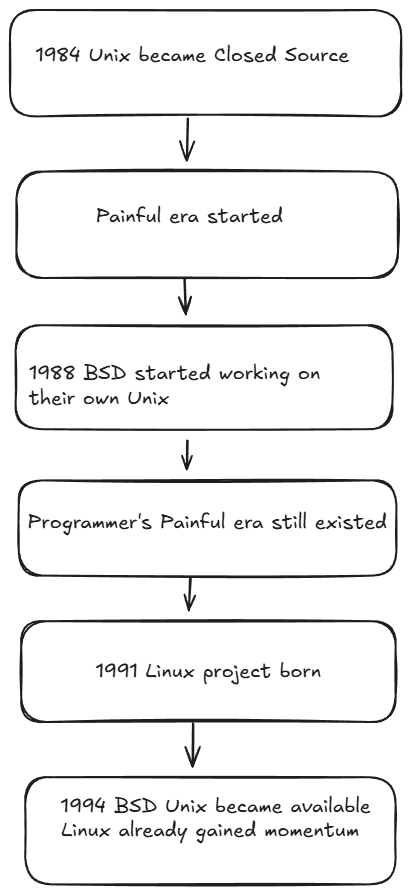
But apart from all the problems, one man was not only frustrated by Unix’s closed source but also because cheap alternatives were not perfect.
While using Minix, OS created by legendary Computer Programmer Andrew Tenembaum, Linus came across many enhancements to the existing Operating System.
After trying to convey his suggestions to Andrew, the creator of Minix, and getting no response, he decided he would write his own Operating System with enhancements he had in mind
POSIX was already established in the market and UNIX philosophy looked the best option to Linus, and then Linux is born.
A trillion-dollar industry existed because of the free and open source philosophy of Linux.
Meta, Oracle every big company modifies Linux according to their use
Android came into existence because of Linux
The wild and exciting journey of UNIX is not only a history, but it is a Research, an Emotion.
Thanks.